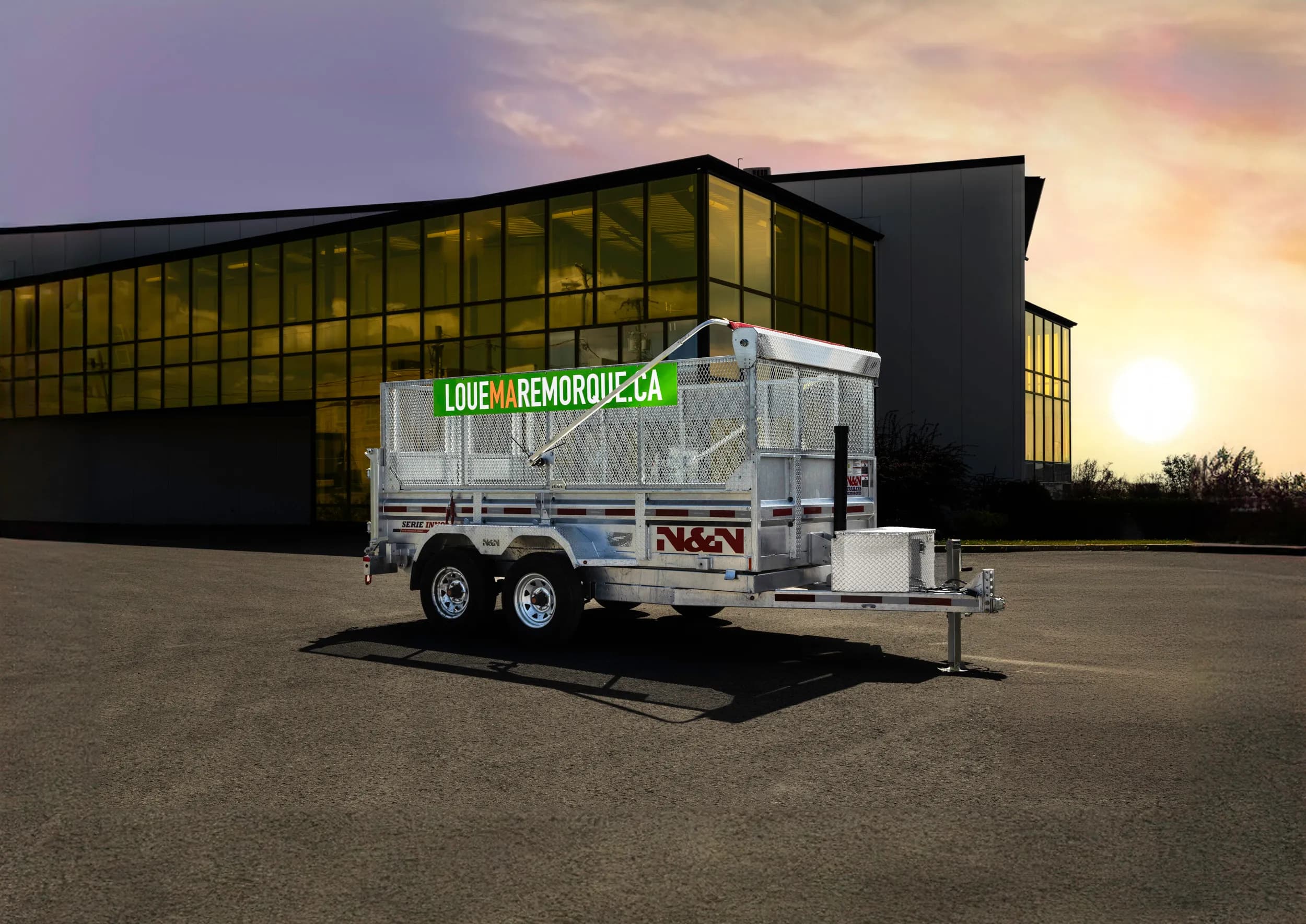
Trailer licensing and registration in Quebec
No, you do not need a special licence. No, there is no reduced speed limit. And no, what you put in the trailer is not insured. What Quebec law actually says.

· · 12 min read
Renting a trailer always raises the same questions, and a great deal of wrong answers circulate. This article draws on the Highway Safety Code and on the SAAQ, and corrects three widespread misconceptions along the way.
One note before we start: this is plain-language guidance, current as of 16 August 2026. For any decision, refer to the SAAQ and Transports Québec, which are the only authorities that count.
Do I have to register the trailer I rent?
No, not you. In Quebec a trailer counts as a road vehicle and must be registered to be used on public roads, with no weight exemption. But for a rental of less than a year the lessor remains the owner under the Code, so we register our trailers. You have nothing to file with the SAAQ.
Two documents do have to travel with you, though. Section 35 of the Code requires the driver to carry the vehicle’s registration certificate or a copy, and for a vehicle rented for less than a year, the rental contract or a copy as well. It is exactly the kind of detail you never discover at a convenient moment. Keep both in the tow vehicle.
Also check before leaving that the plate is in place, readable, and that its light works. Once you are on the road, you are the one driving.
What licence do you need?
A class 5 licence, the ordinary one, is enough to tow any trailer. There is no weight limit on the trailer.
The licensing regulation is explicit: a licence of a class other than 1 and 3 authorises its holder to drive the vehicle that class permits « when that vehicle is towing a trailer or a semi-trailer », the exception covering only road tractors, meaning tractor-trailer trucks. The SAAQ confirms it on its official licence-class poster: « any vehicle covered by this class may also be driven with a trailer attached ».
So where does the famous 4,500 kg come from? It does exist, but it qualifies the tow vehicle, not the trailer: class 5 authorises driving a two-axle motor vehicle whose net mass is under 4,500 kg. In other words, what limits you is what you drive, not what you tow.
Several commercial sites, including competitors and driving schools, claim you need a class 3 above 4,500 kg of trailer. That is not what the regulation says. The 2,000 kg and 4,500 kg trailer thresholds apply only to holders of class 1 and class 3 licences, which is to say trucks.
A probationary licence follows the same rule as a driver’s licence.
Does my trailer need brakes?
Here there is a real threshold, and it catches a lot of people. Section 244 of the Code requires an independent braking system acting on every load-bearing wheel in two cases, and meeting either one is enough:
- the trailer, load included, weighs 1,300 kg or more;
- or it weighs more than half the net mass of the vehicle towing it.
The second case is the trap. A trailer loaded to 700 kg behind a small 1,200 kg car needs brakes, even though it is nowhere near 1,300 kg. And the tow vehicle must have the equipment needed to operate them: in practice, a brake controller fitted in the vehicle.
Our heaviest models, including the dump trailers, have electric brakes and require a 7-pin connector. Every trailer page in our catalogue lists whether it has brakes, its empty weight and its load capacity. If you are unsure about your combination, call us before booking.
What your vehicle needs
- The right hitch ball. 1 7/8, 2 or 2 5/16 inches depending on the trailer. The diameter must match exactly: it is the most dangerous mistake there is.
- The right electrical connector, 4- or 7-pin, plus the equipment needed to operate the trailer’s lights.
- A brake controller if the trailer has brakes.
- Adequate mirrors. Section 262 requires that, when towing, the mirrors let the driver see behind the whole combination. On a wide trailer, factory mirrors are not always enough.
- Enough towing capacity, from the owner’s manual. An honest nuance: exceeding the manufacturer’s rating is not in itself a named offence under the Code. But legal load limits are calculated partly from the ratings on your tyres and axles, a trailer that compromises stability falls under section 471, and your insurer will certainly look at the manufacturer’s rating.
Mandatory equipment on the trailer
Our trailers leave the service location compliant, but the driver is responsible for the condition of the vehicle they are driving. Here is what an inspector looks at, and therefore what you should look at before leaving.
At the rear, section 215 requires, on the last vehicle of the combination: two red position lights, two red reflectors, two red brake lights, two turn signals, and a white light illuminating the licence plate.
On the sides, section 220 adds a red side position light on each side as close as possible to the rear and, for any trailer 1.8 m or longer, an amber side light on each side as close as possible to the front.
Safety chains are required by section 245 for any trailer without an independent braking system able to stop it if it separates. And section 437.1 spells out why they are crossed: the safety device must be installed so the trailer follows the vehicle’s path and the tongue does not touch the ground if the hitch fails. Crossing them in an X under the tongue forms exactly that cradle. It is not a custom, it is how you meet the text.
That same section 437.1 requires the lights, brakes and safety devices to be connected to the tow vehicle and in good working order. It is the provision most often invoked at a roadside stop.
Add mudguards (section 272) and sound tyres. The full 60-second check is in our safe hitching guide.
Securing the load
This is a legal obligation, and an obligation of result: the Code prescribes no method, it prescribes an outcome. Section 471 prohibits driving a vehicle whose load:
- is not firmly secured or sufficiently covered so that no part of it can shift or come loose;
- reduces the driver’s field of vision or masks the lights;
- compromises the stability or handling of the vehicle.
Those three apply to everyone, with no weight threshold. The detailed technical standards (minimum number of tie-downs, strap working loads) come from Standard 10 of the Canadian safety code and target heavy transport, but they are an excellent practical reference.
The fines are not symbolic: the Code provides $350 to $1,050 for a load that is not secured or that compromises stability. And a peace officer who judges a load dangerous can have the vehicle held at the owner’s expense until it is fixed.
Loads that stick out
Two simple, often-ignored rules, in section 473:
- Zero tolerance on width. The load must not exceed the width of the vehicle. Full stop.
- On length, no more than one metre at the front and two metres at the rear.
And as soon as the load overhangs by more than a metre at the rear, section 474 requires a red flag or a reflective panel at its end, plus a red light at night visible from 150 metres. The regulation prescribes no dimension for that flag in ordinary use: go large and clearly visible.
Speed: no special limit in Quebec
There is no reduced speed limit for a passenger vehicle towing a trailer in Quebec. The general limits of section 328 apply: 100 km/h on freeways, 90 km/h on paved roads, 70 km/h on gravel, 50 km/h in built-up areas.
But be careful if you travel. Ontario, British Columbia and several US states do have reduced towing limits. California, for instance, caps any passenger vehicle drawing another vehicle at 55 mph. Check each state or province you cross, and be wary of « towing laws by state » tables on blogs: we verified two against the actual statutes, and one of the two was wrong.
That said, the posted limit is a ceiling, not a target. With a trailer, double your following distance and stay in the right lane.
Insurance: what is covered and what never is
In Quebec, bodily injury falls under the SAAQ public plan, regardless of fault, anywhere in the world. Property damage falls to your private insurance, whose mandatory minimum liability amount is $50,000.
Does the trailer need separate insurance? No. The Automobile Insurance Act expressly includes, within « damage caused by an automobile », damage caused by a trailer used with it. And Quebec’s standard automobile policy form (F.P.Q. No. 1) deems an attached trailer and the vehicle to be one and the same vehicle for liability, whether you own the trailer or not.
For damage to the rented trailer itself, the standard form provides coverage where the trailer you do not own is attached to an insured vehicle used for personal purposes, and is not used to carry people or for commercial purposes. That is the ordinary case of a move or a renovation.
But here is the point almost nobody knows, and it is the most important in this section: the contents of the trailer are never covered by auto insurance. The standard form excludes them explicitly. Your furniture, your tools, the motorcycle you are hauling: none of it is insured by the auto policy, yours or ours.
Two minutes on the phone with your insurer before you rent beats any blog article. One precise question: « I am renting a trailer, does my policy cover the trailer, and what about its contents? » We also offer minor damage protection as an add-on service at booking.
Four things most people do not know
- Nobody may ride in the trailer. Section 428 prohibits riding in a moving trailer or tolerating that it happen. The wording therefore covers the driver too.
- Snow and ice must be cleared before leaving, from the whole combination, trailer included (section 498.1).
- Winter tyre rules do not apply to the trailer. The obligation covers motorised vehicles registered in Quebec. Your tow vehicle must comply from 1 December to 15 March; the trailer need not.
- Brake check areas apply to any combination whose loaded total mass reaches 3,000 kg. That is a far lower threshold than most people assume.
Taking the trailer into the United States
It is possible. Four things to know:
- Tell us at booking. Leaving the country falls under our rental terms.
- Your Quebec insurance follows you in Canada and the United States, and the liability amount adjusts automatically to the legal minimum of the state where the accident happens if that is higher. It does not follow you into Mexico. Be aware too that $50,000 is a very low figure in the American context: talk to your insurer.
- Bring your paperwork. The registration certificate and the rental contract are required by the Quebec Code anyway; US customs advise having the registration available to present on request for a temporary crossing. An authorisation letter from the lessor is a strongly recommended good practice, though not a general federal requirement.
- Equipment rules are state law, not federal: the US federal rules apply only to commercial vehicles. New York, for instance, requires trailer brakes from some of the lowest thresholds in the country.
In short
- The rental trailer is already registered by us. Keep a copy of the certificate and of the rental contract with you.
- A class 5 licence is enough to tow any trailer. The 4,500 kg figure applies to your vehicle, not the trailer.
- Brakes are required from 1,300 kg loaded or half the tow vehicle’s net mass.
- Secure everything. $350 to $1,050 if it moves.
- No reduced speed limit in Quebec, but there are elsewhere.
- The contents of the trailer are never covered by auto insurance.
Article verified 16 August 2026 against the Highway Safety Code (CQLR c. C-24.2, text current to 1 April 2026) and saaq.gouv.qc.ca. Regulations evolve and every situation has its particulars: for any decision, refer to the SAAQ and Transports Québec. For a question about one of our trailers in particular, give us a call — we know the weights and equipment of every model in the fleet.