Which trailer should you rent: enclosed, flatbed or dump?
Four families of trailer, four genuinely different jobs. Here is how to decide in three questions, without ending up one size too small on moving day.

· 8 min read
Most first-time renters pick by length. That is the last thing to look at, not the first. What actually decides is what you are hauling, how it gets into the trailer and what your vehicle can tow. Length comes afterwards, and it is usually obvious once you have answered the other three.
The four families of trailer
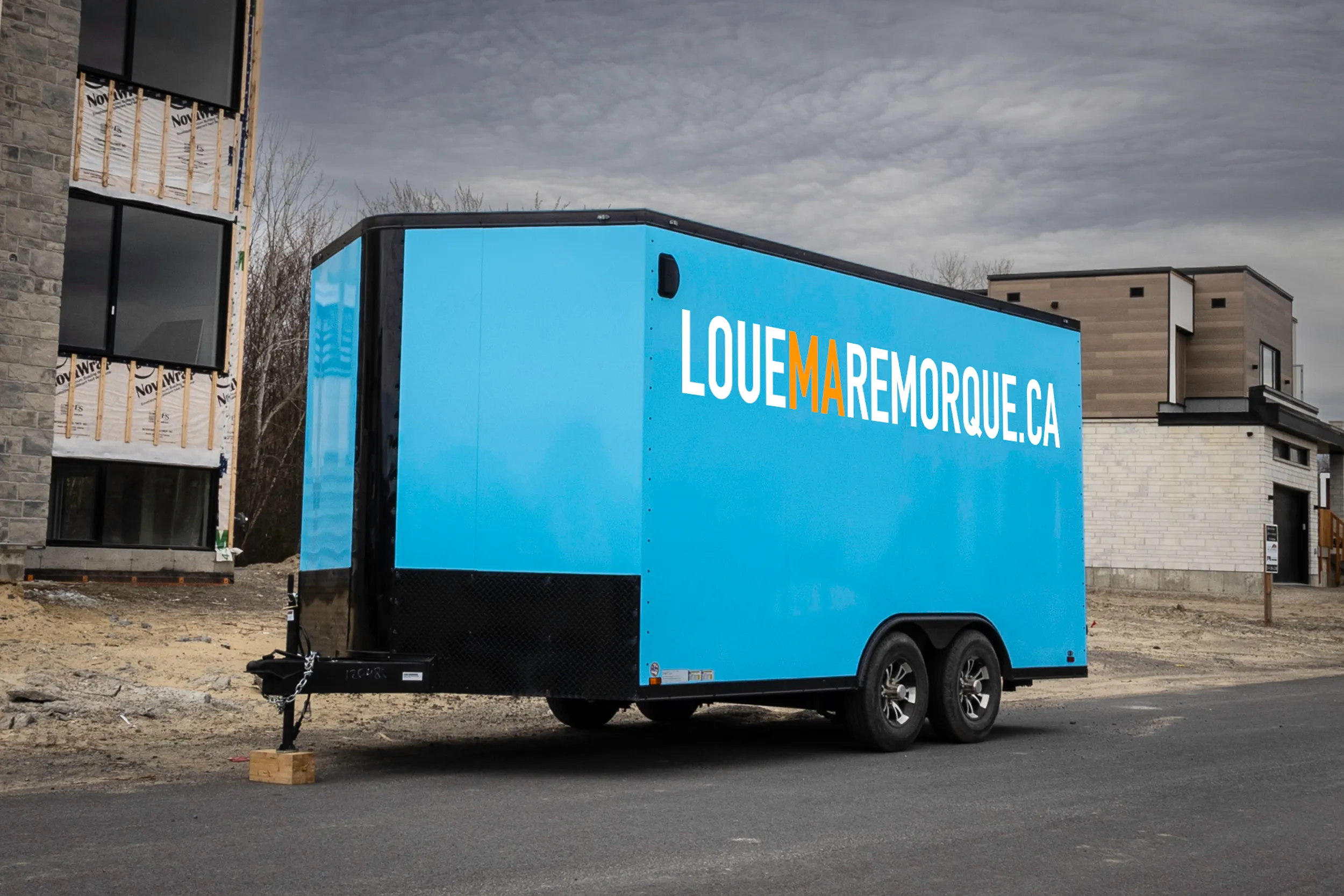
The enclosed trailer
A box on wheels, with a roof, walls and a rear door. This is the moving trailer, the furniture trailer, the one for tools and for anything that must neither get wet nor disappear while you stop for lunch. It locks, which changes everything if you have to leave the load unattended overnight.
Its drawbacks are the flip side of its strengths: it catches the wind, it is heavier empty than an equivalent flatbed, and you are limited by the height of the door. Anything taller than the opening will not go in, however much room there is inside.
See the enclosed trailers, from 10 to 24 feet.
The flatbed trailer
A deck, no walls. You load from the sides, from the rear, or from above with a forklift. This is the trailer for long materials, machinery, vehicles, lumber and pallets.
Two variants come up often. The tilt flatbed tips to form a ramp, so you can drive a vehicle or a machine straight on without handling separate ramps. The raised flatbed has its deck above the wheels, giving a full-width loading surface with no wheel wells eating into the usable space.
Everything you put on it has to be strapped down. There is no wall holding anything back, and this is by far the most expensive mistake we see on this type of trailer.
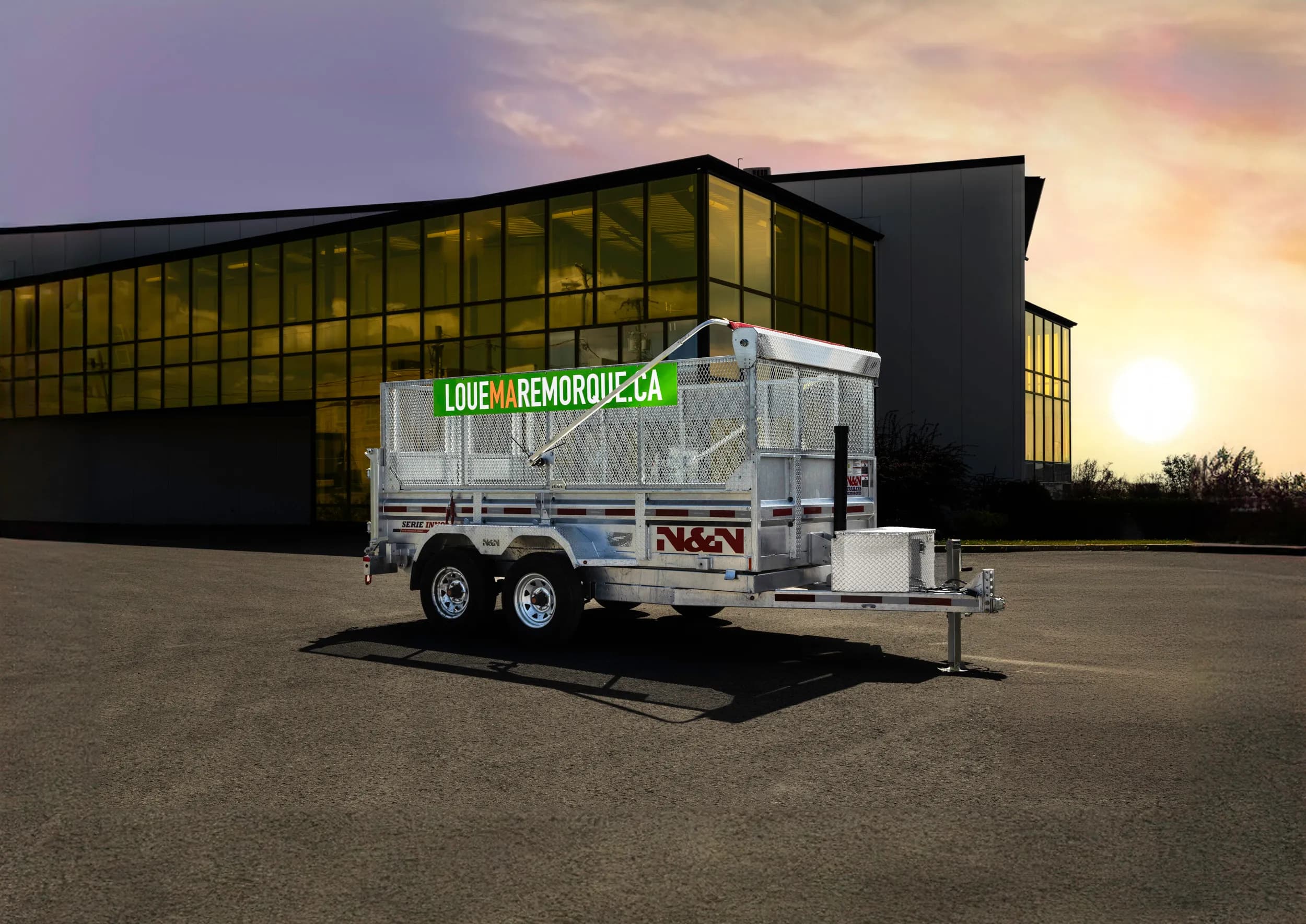
The dump trailer
A hydraulic box that lifts to tip out its contents. It is for bulk loads: soil, stone, mulch, demolition debris, branches, shingles. Its whole reason for existing is to spare you from shovelling out what you shovelled in.
It is also the heaviest category and the most demanding on the tow vehicle. Our dump trailers carry roughly 3.3 tonnes and have electric brakes: this is not a trailer you hitch behind just anything.
The utility trailer
The small all-rounder. Open deck, low sides, modest dimensions. It is for clearing out a garage, hauling yard waste, moving one appliance, or a run to the ecocentre. Its real advantage: it is the easiest to manoeuvre and the lightest, so it is the one the widest range of vehicles can tow.
Three questions that decide almost everything
1. Does it need to stay dry, or locked up?
If the answer is yes to either, it is an enclosed trailer. There is not much to debate. A tarp over a flatbed rarely survives highway speeds, and it protects nothing at all while you are parked.
If the answer is no to both, a flatbed gives you more loading freedom for less empty weight.
2. How does the load get into the trailer?
This is the question people skip most often, and the one that ruins the most days.
- By hand, through the back: an enclosed trailer with a ramp door, or a low utility trailer.
- It rolls (riding mower, ATV, snowmobile, small vehicle): a tilt flatbed, or an enclosed trailer with a ramp door.
- By forklift or excavator: a flatbed, necessarily. An enclosed trailer has no access from above.
- In bulk, by shovel: a dump trailer, or you will be unloading it by hand.
3. What can your vehicle tow?
Your vehicle’s towing capacity is in its owner’s manual, and that is the only source that counts. Two classic traps:
- The rated capacity covers the loaded combination, not the empty trailer. A trailer weighing 1,500 kg empty with 1,000 kg of material in it is 2,500 kg to tow.
- Your vehicle needs the right ball and the right connector. Our trailers use 2-inch or 2 5/16-inch balls depending on the model, and 4-pin or 7-pin connectors. The models with electric brakes require a 7-pin connector and a brake controller in the vehicle.
Every trailer page on this site lists the ball, the connector, whether it has electric brakes, the empty weight and the load capacity. Check those four lines before you book, not on pickup morning.
Picking the right length
Once the family is settled, length goes quickly. A few benchmarks drawn from what our customers actually rent:
- 10 to 12 feet: a studio or a one-bedroom, one appliance, job-site materials, a garage clear-out.
- 14 to 16 feet: a furnished two- or three-bedroom. This is the most requested size for a residential move.
- 20 to 24 feet: a whole house, or any move you want to do in a single trip.
One piece of advice that holds for almost everyone: if you are torn between two lengths, take the bigger one. The price difference for one day is trivial next to the real cost of a second round trip in fuel, time and energy. A half-full trailer costs you nothing extra to tow, only to manoeuvre.
The mistakes we see most often
- Choosing on volume alone. A trailer can be full well before it reaches its load capacity, or the reverse. Hardwood, stone and soil hit the weight limit while the trailer still looks half empty.
- Loading everything at the back. An unbalanced trailer starts swaying at highway speed, and that is hard to correct. Most of the weight belongs slightly ahead of the axle. We go into it in the safe hitching guide.
- Forgetting the door height. A full-size fridge or a tall workbench does not always clear the door of an enclosed trailer, even a long one.
- Booking the day before. In peak season the 16- and 20-foot enclosed trailers go first. Book as soon as you know your dates.
In short
- Does it need to stay dry or locked? Enclosed.
- Is it long, heavy, or loaded from above? Flatbed.
- Is it bulk you would rather not shovel out? Dump.
- Is it small and you want the easiest tow? Utility.
Still undecided? Answer four questions and we will tell you which one to take. Otherwise, every page in our trailer catalogue gives the interior dimensions, the empty weight, the load capacity and the hitch requirements. And if you would rather talk it through, give us a call: two minutes on the phone usually beats an hour of second-guessing.